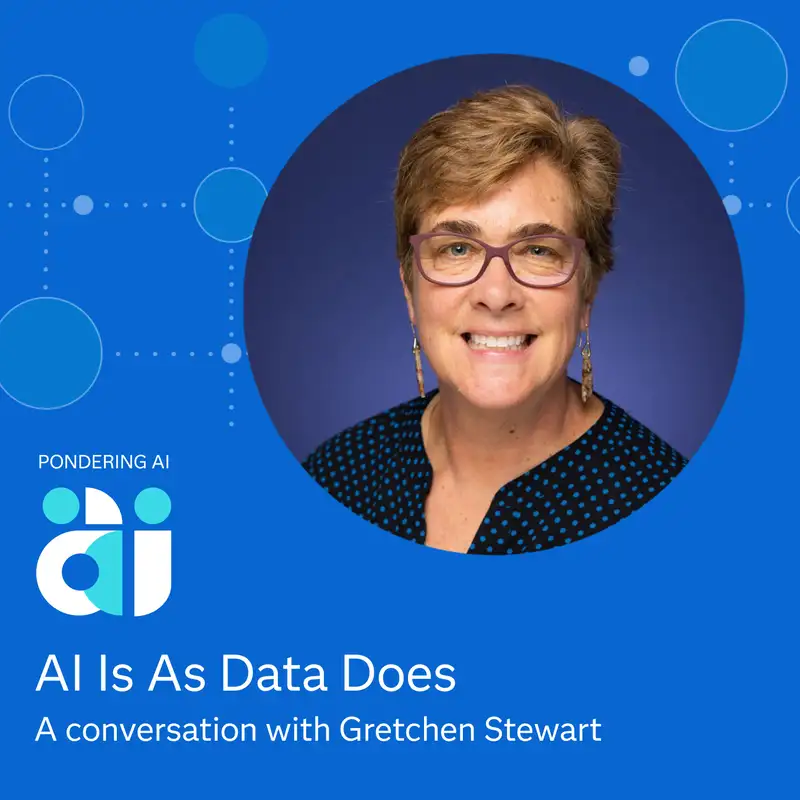
AI Is As Data Does with Gretchen Stewart
KIMBERLY NEVALA: Welcome to Pondering AI. I'm your host, Kimberly Nevala.
In this episode, it's a pleasure to bring you Gretchen Stewart. Gretchen is a principal engineer with Intel, where she serves as the Chief Data Scientist for the public sector and is also a member of the Enterprise HPC - or High-Performance Computing - and AI Architecture Group.
She joins us today to talk about the foundational requirements for AI success. And spoiler alert, it's not all about the model. So welcome to the show, Gretchen.
GRETCHEN STEWART: Thank you so much. I'm so excited to be here and to have this conversation with you. You and I have spent a bit of time already talking, and I know that this will be a lively conversation, some of which is probably Intel OK, and some might not be, but I really don't care.
[LAUGHTER]
KIMBERLY NEVALA: So on that note-- Now, Gretchen, you actually studied mathematics back in the day. And I'm wondering if, back then, you had an inkling or, in fact, the express intent of ultimately working in computer and/or data science, including AI?
GRETCHEN STEWART: That's, honestly, a great question. So for me, the parts of math that I really liked were linear algebra and numerical analysis, a lot of which is the basis and already was the early underpinnings of artificial intelligence. So absolutely, I knew that that was something I wanted to do. My first job out of school was working as a software engineer for a computer company and have always spent my career doing that.
But back in 2018, honestly, I realized what was happening. I saw what we, Intel - well, at time, I was just starting at Intel - but I saw what Intel was doing. I saw the expansion of storage and memory and network and compute and all the work that was being done that was going to allow a lot of those math equations that I learned to really be able to unleash something pretty exciting. At that point, I went back to school and really undid those cobwebs, so to speak, and said, OK, I really need to brush up and also be prepared to understand and to be able to live with and be part of what is happening today.
KIMBERLY NEVALA: Awesome. And so certainly what is happening today is AI - and I'm going to refer to that there as the royal AI - and so one of the things that you and I have talked about, and I'm interested to get your thoughts on, is the importance of definitions. And being very clear about what it is we are talking about when someone says AI. Or tells us that they want AI as part of a solution or as the solution, as the case may be.
So what are you observing right now-- or what are you hearing when people ask for AI? What is it that they're actually asking about, more or less, these days?
GRETCHEN STEWART: Yeah. I mean, a lot of people think AI really has just started in the last few years, not realizing that the first conference to discuss machine learning and artificial intelligence was back in 1956, before you and I were even alive.
And so the thing that I see today is when someone says, I need AI, they are thinking about the frontier models. They're thinking about large language models. They're not thinking about the fact that they're already using a lot of AI. And in the end, when you start to peel back what the challenges are that they're trying to face, things like recommender engines or fraud detection or predictive analytics are really more of what they're looking for than large language models.
There are absolutely times when large language models are the answer. But today, when you say AI, people immediately think, oh, I need an LLM, I need ChatGPT. And that's not always the case.
KIMBERLY NEVALA: So I guess, at the risk of being a little bit tongue in cheek, so AI it's sort of becoming, it's like tissue, Kleenex for tissue. So it's AI for GenAI or GenAI for AI is really probably more the case here. But how does that actually manifest or cause problems in enterprises, in companies, when they are trying to develop an AI strategy or even deciding how to go about solving any given problem?
GRETCHEN STEWART: You know, Kimberly, I have, as you know, been working with government customers for a long time. And back in, I think it was 2017 or 2018, the requirement was that every agency within the government had to have a data strategy. And that was the right thing to do.
Because when you really talk about leveraging artificial intelligence today, leveraging those math techniques to be able to solve problems, it all starts with the data and understanding and having your data strategy really laid out and understanding where the data is that you need. Also, where is the data that someone else might have that you need. And really start to build not only what is that data strategy, what is the data lake or data swamp or whatever somebody might want to do, but also the governance. What does that mean for you in terms of negotiating? How are you reviewing the data? How do you ensure that the data is accessible quickly? How do you create almost the old standard of the business recovery and some of those kinds of things that you build into your whole data strategy?
And I find that there are a number of customers today who have chief data officers, and those people are really working on their data strategy. And smart for the government to say, five, six years ago, now seven years ago, excuse me, we need to do this, because, as an example, during that time when the Department of Defense was putting together their data strategy, they came to the realization that their data is a weapon system. That, without that data, that they cannot do the kinds of things that they need to do to prevent going to war or to be able to be actively participating in a way to ensure they're saving lives.
And they said, one of our weapons systems is our data. And so really walking through that process.
And as you and I always say, AI is a team sport. So making sure that you've got all the right people participating from the beginning of laying out that strategy and then also knowing that it's not one and done. You absolutely have to continue to revisit it. You have to continue to rotate members in and out so that you really continue to grow and expand and ensure that your data and the whole process that you're going through to help solve your business problems is done well.
KIMBERLY NEVALA: There is often a tendency - and I think it's justified both due to some of the PR and the hyping - that when we start to conflate AI broadly with just generative AI and then we start to think about the experience that we have. For instance, just as consumers, maybe outside of the corporate realm with being able to just quickly spin up a chatbot, ask it a question, it will always come back with an answer. Correct or not, mm, whole different conversation, perhaps.
But I'm wondering if, when that conflation starts to happen, does it impact how decision makers, business people, maybe even pressures that the team's delivering these analytics, AI, data solutions feel, to not necessarily focus in on all of these foundational elements? Is there a sense today that, well, can't we just do this really fast with an LLM?
GRETCHEN STEWART: Yeah, I think you're absolutely right. And that many people, because LLMs do respond back to you where it almost feels a bit human, and so I think people make assumptions. And assumptions are making an ass out of you and me. I mean, that's what my dad used to tell me a long time ago.
And that people do make a lot of assumptions that this work is fast and easy. Yet not realizing that companies like OpenAI and other researchers have been working on this for decades and it isn't something that just happened overnight. And that combination of the immediacy; people think that it's simple and fast.
I'll use Intel as an example, honestly. Back in - I think it was like 2014, 2015 - so 10 years ago, Intel said we need to transform our manufacturing process because of the fact that we are collecting more and more data. There's more and more partners. There's more and more product components, et cetera. And what they did was really, again, start with looking at that data and understanding who had that data. Where was the data coming from off of different machines? How quickly did people need to analyze that data?
And literally, we went from collecting maybe a couple hundred terabytes of data to over a petabyte worth of data at every single location, every day, in our factories. So think about the amount of data. So each of those locations has their own databases and data. And then there is a central location where some of the most important data goes to ensure that we're leveraging the logistics between all of the manufacturing facilities.
But, again, it's one of those things that I truly believe. That, again, LLMs look like they're really easy, and you talk to Copilot and others, and it responds quickly, that people really do not understand the complexity of the infrastructure and the complexity of the data and the math that are needed behind it.
And you and I have talked about this, but I think one of the things that we all need to do and I love to do as often as I can is to go back into grade schools and go back into high schools and talk to people and students about being data savvy. And you don't have to be a mathematician. You don't have to be a PhD in data science. But everybody's got to be data savvy. Everybody uses AI and you're either going to be in the loop or on the loop. And understanding how you do that and can do it with a critical eye, i.e. as you said earlier, yeah, some of the data, the responses that come back are not always accurate, but they sound good. And really being able to understand how to interact that way because it's here. It's going to get even better. And yet I think sometimes we make a lot of assumptions.
KIMBERLY NEVALA: And do you think that organizations or people thinking about this spend enough time really taking that step back to say, what is the problem that I'm trying to solve? And what is actually the complexion of that problem? So what is the business practice? What is the business process?
Because there is also, sometimes, or there can be, I guess I should ask this. Is there a tendency to think that if I just start collecting all the data I can, all of the digital detritus, somehow that means that I'm going to have enough information to be able to automate or to be able to switch out this for analytics or to the agentic Ais, the new piece? So how important is it also, to make sure that, as you're thinking about a problem to solve, it's not just, wow, I think there's some data but do I actually understand the business process at a detailed enough level so I can even make the assessment of does it make sense to automate or augment this process? And does the information that I'm capturing today or have access to today actually support that augmentation or not? In which case the project or the program is not necessarily we can't use analytics or AI, but it may be that we have to develop some other components, including data. So, interested in your perspectives on that.
GRETCHEN STEWART: To your first question, Do I think that people really think through the process? The answer is no, because there is so much complexity and because you have - sometimes it's a chief data officer - who comes more from a line of business and the understanding of the business. Or in some cases, you've got the folks in IT that are kind of taking the lead. Those perspectives are very different, and yet you need both.
And so what I find is that, in many cases, like the data itself, the teams and the people looking at are siloed. And so you don't get the full picture. And to your point, you need to step back and see the forest for the trees. And I think in the world that we're living in today, with things that are moving so quickly and the assumption that things like generative AI can just solve the problem and I can move on, just becomes this snowball effect and I think make it more and more challenging.
And yet, stepping back and really mapping out to me, I call it mapping out the data flow, the workflow is to me, lots of times, is really interesting.
Because as you sit through and, let's say you're thinking about the permitting process for making changes to your home, and you step back and go, OK, so what do I need to do? First, there's the surveys that you might need to do or the architectural designs. And you start to think through the whole thing, and there's lots of times of like, oh yeah, I didn't think about there's also plumbing and electrical. And so, I mean, when you've got a group of people who understand bits and pieces of it - because, again, everything that we have today is so integrated and so complex that no one person knows it all - and having that group of people with different knowledge.
So as an example, I sit on the Responsible AI Council at Intel. And we literally review the models. We look at the things that we're not only building internally but what are we building from a component perspective that could be used, and how could it be used, by someone? And are there things that we're building in to ensure audit traceability, to ensure explainability, if you're leveraging our hardware to produce whatever the model might be producing?
And the fact is that we have engineers, like myself. We have HR people. We have legal. We have security experts. We have salespeople. We have the plethora of different perspectives involved. And there are lots of people who ask some of the most interesting questions that I wouldn't have thought of, because, hey, I'm about the widgets. And I want to make sure that it's got the right gates and that we're looking at bfloat16 and that we're able to do half precision and full precision, et cetera. And you have an HR person who might say, yeah, but could the jitter and the light be able to show someone that they moved into a different environment that could be prohibitive? Or whatever. I mean, I know that probably doesn't make any sense, but they at least ask questions that you wouldn't think about.
And I think that that's why I always say to people, AI is a team sport. And if there's somebody who says to you that they know everything, they're full of crap. There is absolutely no one person who knows everything about AI. So I struggle sometimes with those pontificators that you see at all these different conferences who have all the answers. And I'm like, yeah, no. [LAUGHS]. Not at all.
KIMBERLY NEVALA: Yeah. I wonder how much, or if, we're also doing ourselves a disservice, then. We do talk a lot about things like citizen developers, for instance, or having folks in the business able to now develop, whether it's an agent maybe - that's typically, we're talking there about an encapsulated sort of widget doing a singular thing.
But somewhat implicit in that discussion is this idea that somebody can just do more. And maybe I, who don't have deep technical expertise can now get my hands on this - whether it's vibe coding or whatever that is - and without having to really understand the details of it can now start to work through that.
And so, A, is that a reasonable assumption? And where might that lead us wrong? And then, B, my question is, do we have to start thinking differently about teaming strategies and also about understanding and appreciating different kinds of knowledge? And so, yes, we want to enable lots of people to do lots of things, but maybe it's not enabling everyone to do everything singularly.
GRETCHEN STEWART: Yeah. And one of the things, I think it was probably in the last couple of weeks, I saw an article, I don't remember if it was in LinkedIn or maybe it was on Substack. But it was a person who is a hard coder and ultimately leveraged no-code and low-code tools and then couldn't figure out how some of the things had been done.
And I thought it was really interesting that they were like, you know, you still have to have guardrails even if there's no-code or low-code options that you're doing. Because, again, he was saying, then I tried to peel back the onion to say, well, why was this the answer here versus what I was thinking it was going to be? And he said because I didn't code it, I wasn't sure. And therefore had to pull out the information, i.e. the code base. But in some cases, he said, it wasn't descriptive enough for me still to be able to uncover what I was trying to find.
So I think, to your point, Do we do ourselves a disservice potentially? I think that there's never, we're never, going to eliminate people who understand how to program. Despite, I think, what Jensen says, who's like, we won't need coders anymore. I think you're still going to need people who understand if-then statements. What is a loop? How does this work? And maybe they aren't doing the programming themselves, but you've got to have that understanding to then be able to pick apart and explain what the low code or no code is that you have.
And for some of us who, or people who want to create little chatbots that help them do some of their daily routines, I think awesome. Go for it. I think that's really cool. And honestly, one of the things I love about SAS, not only that I have been using it since I was in college, but the fact that whether you understand R because you're a statistical person or you're using Python because that's the newer version, you can leverage those visualization tools and then be able to see the code behind it.
So I think, also for people who don't even understand that, that's also a great way to educate them. And they may still not want to spend their days coding, which, truthfully, I did it before. I don't want to do it anymore honestly. I have people on the team that I'm on who are sophisticated coders, and I go to them all the time because I'm like, if you want to know about Fortran and Pascal, I'm your girl. If you want to know about R, I'm the person because I was a statistics kind of person. But I'm not a great Python programmer. And so I ask other people or I use tools that then show me what the code looks like so that I can learn.
And I think I totally digress from the original conversation, but I don't think people think about it. And I do think, in some cases, we are doing ourselves a little bit of a disservice by assuming. I mean, computers are still garbage in, garbage out. I mean, these are not brains. I mean, we are developing brain-inspired processors, but it still is not as sophisticated and as complex and has the ability that our brains do to evaluate.
KIMBERLY NEVALA: Yeah. Well, I think the other interesting point there is that you, as a long-standing programmer - I happen to be a chemical engineer, so I also was originally trained up in Fortran, which, weirdly, still highly used because it is reliable, --
GRETCHEN STEWART: Absolutely.
KIMBERLY NEVALA: It is repeatable. And it beats on in chemical engineering.
GRETCHEN STEWART: And researchers are still using Fortran. So yeah.
KIMBERLY NEVALA: So anyway, none of these things have been fully replaced. And maybe that's a piece of it.
But I think maybe the other point there is that you have a level of - it doesn't necessarily matter that it's the most recent language - but you have an understanding of how the logic works. And so you can look at something, and I bet you could even look at something in Python, even though you're not the best, and say, I'm not quite sure if this is doing this right or you know maybe where to poke at. And I think developing that level of expertise in something to be able to have that logical reasoning is important. And how we go about that, I don't know, but I think it's something we have to, we'll struggle with.
The other thing that struck me as you were talking there was someone saying, oh, I've generated this code and low code. But it's also like, how much do I really understand, for instance, the data and the information that's getting pulled out and how the model is using it and spinning it out?
And just so that we're not picking on the technical side of the house here. Athough these days that line between business and IT is nowhere near as discrete as it used to be back in the day and we tried to chuck things, requirements, over the fence. And then solutions came back and bopped us over the head coming the other way and then chucked them back. And so I'm glad we're not there anymore.
But I also find when we're thinking about, especially in these days of agentic-- because, again, I’ll be interested in your perspectives on how people are defining agentic and maybe how we can think more critically or more precisely about that so we have the proper expectations. But we tend to look at certain processes and say, oh, this is document heavy, or there's a lot of steps in this, and maybe we can just do that. And then when we sit down with somebody-- even in the business, they're like, yeah, these are the steps I take: step 1, step 2, step 3. And when you poke a little bit harder, they'll go, oh, it's not really if then. It's if then, except, but, maybe except for. Think about that thing, right?
So it's all those exceptions that happen in the course of the day or in the course of the practice that are almost unremarked upon until they aren't able to be accounted for in the system itself. And then all of a sudden, this little thing that's kind of a consistent little buzz in someone's ear or a little action they're taking and they're not even thinking about it can torpedo a whole system that people have worked really hard on. And so I think there is, in some ways, as these technologies become easier to use, we have to be more deliberate in understanding how we're designing the system and how we want to implement them. So that's a little off side of my own. I don't know if that's even practical.
GRETCHEN STEWART: No. I absolutely agree with you.
And I think, in terms of the agentic AI definition, I think for certain people at certain levels in a company, that means I get to eliminate employees. I think for others of us, we know that it's almost RPA on steroids. So robotic process automation, remote process automation, whatever you want to call it. But back in the day, people would walk through and map out the work that they do and figure out, are there ways that we can automate portions of it?
And that's really what agentic AI is to me. And again, it's kind of like 12 or 13 years ago, cloud was the answer. What was the question? Now, today, agentic AI is the answer. What's the question? And everyone's definition is all over the place. But I don't view, to leap off of what you were saying, that it's going to really eliminate jobs or that there's those if, buts, et cetera. I think there are components of people's daily jobs that are really rote and can be done by an agent. But I still believe that there will be a human on the loop or in the loop evaluating some of the results that come back.
Will an LLM that is searching through all of the legalese for Department of Transportation and spitting out the best information for somebody be something that we would continue to want to automate? Absolutely, because that search is so much faster than somebody flipping through pages or trying to search on Google or whatever. So I think there's lots of those things that will continue to do more and more and even have some of those agents produce information that then another agent says, well, if it's any of these rules, then this is what we'll do. If it's not, well, then the human needs to review it.
So I think there's definitely places that we are going to be able to automate and help. But do I believe that immediately it's going to eliminate jobs? No. Some of the companies that I've seen that said, OK, we're going to be able to automate, so we're eliminating, and all of a sudden they're having to rehire some of those people back who have the expertise for the well, if it's this, it should be there. And if it's this plus this, then, oh, this needs to move over to this particular process, et cetera.
And so it's like, mmm-- it's not as simple as people think. And again, it just reiterates the complexity of the world that we live in and the complexity of the data and the complexity of the multivariate algorithms that are used to make these kinds of decisions. That you need a bunch of people involved in reviewing and continuing to review, because there are model drifts. There are challenges with is the data continuing to still be cleaned and cleansed and accurate? Or are there now, because the process itself has some additional components, there's additional data we need. So that changes it. So it's just, it's not a one and done ever, I think. Again, I may be totally wrong, but that's--
KIMBERLY NEVALA: Not yet anyway.
GRETCHEN STEWART: [LAUGHS]
KIMBERLY NEVALA: So you mentioned, is the data quality there? Is it comprehensive? And this is another area where, do folks have a sense of what data quality means or what it means for information to be robust, to be complete, when we're talking about non-structured data sources? If we're talking about data quality for structured data, operational data, people can understand is the thing filled in? If we're talking about a zip code, there's a fairly obvious component there.
I'm not entirely sure, and because you're kind of really smack dab in the middle of this data engineering and componentry and I know this is an area of passion for you, do people have an idea or an understanding of what data quality means when we're talking in the context of unstructured data?
GRETCHEN STEWART: Right, right. Yeah. I think it kind of depends on what the unstructured is.
If it's some of the customers that I work with where the unstructured is literally radar data, and it's all about can we hear the right signals within the noise, a lot of which is really the basis of a lot of what algorithms are trying to do, to try and find the good data, I do find that there are people who, to your point, make the assumption that if I've got this much data and it's unstructured, it's still valid.
And the truth is you need to understand what some of those, I'll call them categories or characteristics of the data are. Because sometimes you'll find that you may have terabytes of data but the characteristics that you're looking for, you don't have a lot of that. And so it really is very thin data. And if the datas are thin, then what do you do? Do you need to create synthetic data based on the right characteristics to then be able to train your models and then be able to leverage some of the, I'll call it future unstructured data, to be able to find the real information from the noise? And I think that you can understand that level.
But the truth is, if you are talking about radar data, I'm not a radar expert. So I need a radar person to really help me understand the characteristics. And you're talking about multiple wavelengths, and you're talking about leveraging different points within the wavelength and spectrum that a lot of us don't understand. And so it really, you always have to have - what would I call it - a domain expert to really make sure that, even with all of that immense unstructured data, has it got the right characteristics for you to be able to come up with great answers?
I mean, ChatGPT, I mean, we know that the majority of how they got all their data is to scrape the internet. More than half of the internet is just crap. So you know what I mean? So there's lots - and I don't mean it in a bad way. But, I mean, it's people's opinions. It's a little of this. It's a little of that. It's not always the most accurate and also doesn't have the kind of characteristics that is of the data that you're trying to get information from.
KIMBERLY NEVALA: Yeah, it is interesting. I mean, we could argue that we should have always been consulting with the experts from the business when we're dealing with data. But I think when you're dealing with things that are numbers or in very discrete fields, even when they're text, it's easier to convince ourselves that we really just can't understand it because it's very compact. It's very easy to manipulate.
And so is this a situation - and I'm interested if there's other areas of just these fundamental or foundational data practices or AI engineering, analytic model engineering practices – that are being, the need for it, is now being - maybe we thought, initially, we don't need to do this, but actually we really do. And the need for it to actually be is now reinforced. So organizations that have these sorts of good foundational practices are now prepared to really run with AI in all of its forms and flavors. And those that have not addressed them are finding it as a sort of a hard stop.
GRETCHEN STEWART: I think that the truth is, because of who we are and because of all the businesses, the assumption has always been the more data we have, the better. And I think that in a lot of cases, especially as you've added automation in manufacturing and the internet of things that's collecting a ton of data, that people have assumptions that more data equals better. And I don't think that's accurate.
I mean, I think there's a lot of data that we're collecting, data that I collect, that is just junk. And at the end of every year, I go back through my old emails and files and PowerPoints, and I'm like, why the heck did I bother to keep that? Or other things like, absolutely, I do need to. So I think some of the old school of rules based, what's good, what's bad, sometimes still apply. And so really having a fundamental understanding of data, good data, what does it mean to have your datas that are thin?
And to your point, as a chemist or as somebody who's at the CDC, they're all about data. And they are absolutely all about data quality related to the focus that is their expertise. And again, it's that domain expert with the data engineer. But I also think that just understanding some of the characteristics of just good versus bad, 0 versus a 1, to really be able to lay that out as you move forward with whatever AI project you're doing what makes the most sense.
And again, I don't have all the answers. And I think that, again, as anybody who thinks that they do, I mean, you always have to go, OK, where are your data streams? How are you going to ingest that data? Are you using things like extraction, transformation, load, ETL? How do you integrate that data? How do you assume the data's AI ready? How do you then serve up that data for different people who have different roles and need different access? How do you characterize the models? How do you keep those models in some sort of a check so that people-- almost like the library, you can check them in, check them out. But at the same time, how do you ensure that those models don't drift?
I mean, so there's just-- it's not simple.
KIMBERLY NEVALA: No, it is not simple.
Now, I want to take a quick sidebar, because you had mentioned, when you think about agentic AI - and there is no standard definition at this point - we are seeing definitions that are becoming more and more, I think, operational. And we're sort of tightening down a little bit about it's not just an agent that goes out in pursuit of a goal, does its own thing. Even on the big stages, we're seeing that be a little bit more discreet.
But you've also said that people are very loath, they really don't like, when we talk about this as just really maybe it's even really smart or really advanced automation. What do you think it is about the terminology? Why is that such a bugaboo for folks or such an issue?
GRETCHEN STEWART: Well, yeah, that's a really good question. I mean, I have to say, my biggest pet peeve about the world that we live in is people talk about hallucinations. And I'm like, but hallucinations are things that humans do, not systems. Systems just have crap answers. Garbage in, garbage out.
And so I think because of - I feel like we try to anthropomorphize, I think that's the right word. We try to anthropomorphize systems, i.e. make them more human, because then it's easier for us to work with them. And you and I have had that conversation about, do you trust the system? And I feel like LLMs have allowed people to feel like they can trust them more because the responses feel more human like. You feel like you're having a conversation.
But I do feel like we have done a disservice to leverage human characteristics as the machine. It is a human plus a machine. It is never a human over the machine. I truly believe the droids and cyborgs are not going to come down and take over the world. I mean, I love science fiction. I think those things are fun. But do I think it's really going to happen? No.
KIMBERLY NEVALA: Well, I like sci-fi, as well, but most of the things I read, I'm like, I don't think I want to live there actually. I always have this question in my mind, which is why are all the worst things about the way society works today always, even in these future-looking shows, recreated in some form or fashion? We've got to be-- we're smart. We should be able to think differently about this. So there's always that element of whatever divides you want to look at - sort of class or access or power, money - that always seem to get replicated. And I'm like, I would really like to see one that's not sort of Pollyanna, but someone thinking differently about maybe we don't have to pull all of these things forward into the future.
GRETCHEN STEWART: Well, and it goes back to the beginning of the conversation you and I were having is that you need different people in the room.
I mean, if you look at the large language model providers today, they all look the same. The people that are running those companies look the same, come from very similar backgrounds, similar colleges, similar education. I don't think that's the best. And I could put a big feminist hat on or whatever.
But I think the truth is you need people with different perspectives. You need diversity, equity, and inclusion, especially when we're talking about artificial intelligence. I mean, Joyce-- excuse me-- Dr. Buolamwini and I know I'm bastardizing the last name.
KIMBERLY NEVALA: Joy?
GRETCHEN STEWART: Joy. Thank you. When she did her initial work on computer vision and the fact that it was not recognizing her face as a Black woman. Again, it just goes back to, well, what were the systems originally trained on? They were trained on the Fortune 1000 companies. They were trained on people that are in Congress. They were trained on people that are in parliament. Those people all look the same. And so when you put somebody who's a little different and all of a sudden she, as a 21-year-old at MIT, was labeled a 45-year-old aging white guy. No.
And so, I mean, we have gone forward and corrected some of those things. I honestly don't believe that people do that maliciously. I don't think that they're thinking, hey, I just want only people who look like me, to be like, to have the process move forward so that it's only about us. I think that it's just that's what they're used to. And unless you start to add people in to ask that annoying question that I used to ask from the time I was in first grade and people couldn't stand me, why? Why are we doing it that way? Is this the right data? Is this the right sets of datas? Are we looking at this the right way?
KIMBERLY NEVALA: And you've also said, and this is an area that I am heartened by I have to say, you've said that one of the core competencies of a data scientist or an engineer needs to be an understanding and an appreciation and for governance and ethics. And I think you can go the other way as well and say someone who's doing governance and ethics needs to have an appreciation for what the technology can and cannot do and those two things coming together.
But do you see that kind of more interdisciplinary training and, at a minimum, awareness; which maybe you don't know to ask the question, but you know that you might need to go to find someone to ask those questions. Is that becoming more prevalent and prominent in organizations that you're working with across the board or--
GRETCHEN STEWART: Yeah. Again, I'm dealing a lot with public sector customers. And the answer that I would have given you 18 months ago is very different than the answer now. I'm not seeing a good trend with the customers that I'm working with. But I'm going to hope that that turns around and that people are looking and thinking about governance.
When you have-- again, I'll use the Department of Defense as an example. You've got multiple services, and you've got air, land, sea, space. And you've got data that's coming from all of those to be able to give you the full picture situational awareness. But land is Army. Sea is Navy. Air is Air Force. Space Force is space. I mean, so you need all four of those working together to produce a full situational awareness, which means governance. Which means that the services have been set up separately, they have to work together. They have to break down those silos. They have to have those conversations to be able to ensure that you know, is that a good guy? Is that a goat? Is that a bad guy?
And so I think the same things need to happen in enterprise businesses. The ones that I've worked with, whether financial service or health care, they’re definitely very role based. And they're beginning to knock down some of those silos because the datas are everywhere. And how do we leverage those? And then how do we, as the nursing staff, work with the doctors, who work with the administration, who work with the patients? There's information everywhere that needs to be leveraged.
And I'm seeing a lot more of those kinds of cross-functional teams be created. But in some cases, with some of my customers, those have, over the last nine months, all been eliminated.
KIMBERLY NEVALA: Yeah. That's unfortunate. Hope we'll see that trend go the other way.
Well, there's an interesting element of that, as well, which is we have also, then set up - and if we get down into your standard organization or company - business functions that are very much siloed and have their own processes and all that. And over the years, we've talked about going end to end, looking from the customer's perspective or the employee's perspective for that.
And so it's interesting as we start to talk to folks about what data are you using? For instance, as a nurse? And what as a doctor, what are you capturing? I do wonder and I hope to see - and again, this has absolutely nothing to do with the technology - if those conversations where we're trying to enable technology also give us the opportunity to really understand better where those fundamental processes and practices are working well or not working well at all. And therefore, maybe we are automating things, but maybe we're not automating it in the way that it happens today. But also, in some cases, we might just say, maybe we need to rethink this practice as a whole.
GRETCHEN STEWART: Yeah, yeah. And I'm really hoping that whatever your definition of agentic AI is, that it really does have people sit down and really map out the data flows and really think through the steps and processes that people go through, including the nuances and the exceptions. That it will allow people to really look at leveraging technology for the best. AI for good, not for evil.
KIMBERLY NEVALA: Yeah, absolutely. So as we wrap up here, Gretchen, any final thoughts or notes you'd like to make for the audience, things that we haven't touched on or that you're really encouraging folks to focus on as we move forward here?
GRETCHEN STEWART: I think don't be afraid. And to your point earlier, have some trust. But trust has to be verified, and it has to be leveraged with a real critical eye. And it's OK if you don't know. Feel free to ask somebody. Feel free to ask why. And also, don't assume that just googling something is the accurate answer.
KIMBERLY NEVALA: Yeah, yeah. And I'll add in my asterisk, which is, or asking ChatGPT.
[LAUGHTER]
GRETCHEN STEWART: Yes, thank you.
KIMBERLY NEVALA: It might just be we start to use Google for all of it or the other way around, so who knows. Anyway, awesome. Well, thank you so much. I really appreciate your time and your insights. I always have a great time chatting with you and look forward to doing more of this in the future.
GRETCHEN STEWART: Absolutely. And again, thank you. This was-- I can't believe the time went by so quickly. Thank you.
KIMBERLY NEVALA: Excellent. And for all of you out there, if you'd like to continue learning from thinkers, doers, and advocates such as Gretchen, you can find us wherever you listen to your podcasts and also on YouTube.
Creators and Guests