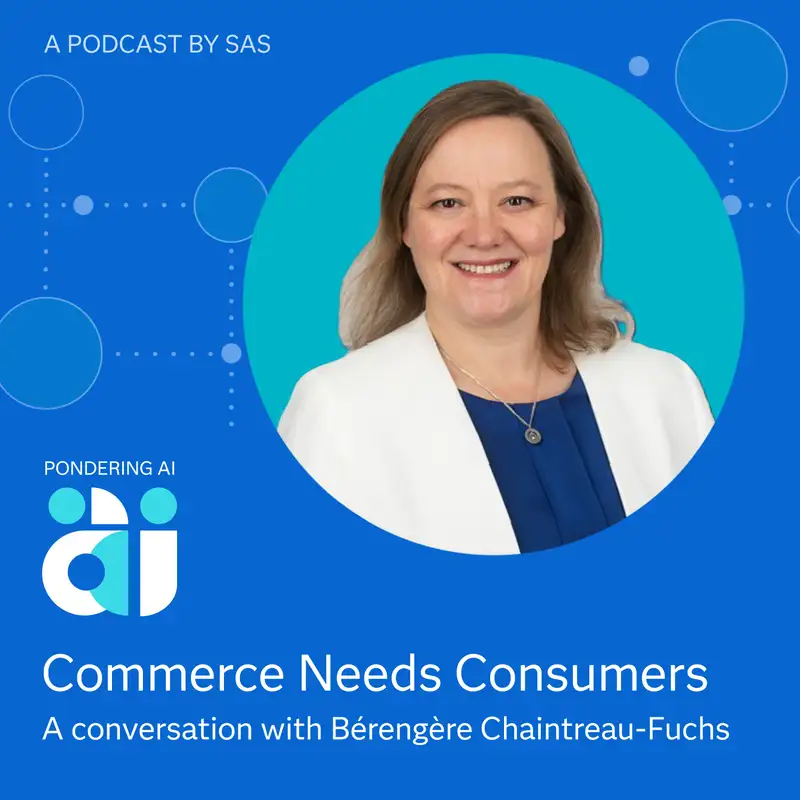
Commerce Needs Consumers with Bérengère Chaintreau-Fuchs
KIMBERLY NEVALA: Welcome to Pondering AI, brought to you by SAS. I'm your host, Kimberly Nevala.
In this episode, we're pondering consumer decision-making and the evolving landscape of trust with Bérengère Chaintreau-Fuchs. Bérengère is a digital commerce expert whose extensive bona fides include stints at Kantar, Amazon, and eBay. Bérengère, welcome to the show.
BÉRENGÈRE CHAINTREAU-FUCHS: Thank you very much, Kimberly. I'm very happy to be here.
KIMBERLY NEVALA: We're so excited to see you. Now to kick things off, I wanted to know if your early studies in history and philosophy have influenced your work and, if so, how?
BÉRENGÈRE CHAINTREAU-FUCHS: Oh, that's a very good question, actually. So I think I will start to say that initially I thought that they weren't. And that I was a digital commerce person that was learning by doing. But the more now I'm thinking about how people are making decisions and how we also, as consumers and as retailers, we bring all of this together, the more I go back to history - to think about how people have done this in the past. But also much more about philosophy as well. Because philosophy is about thinking about concept and definition; using something to describe something else and look at the tension between the two. It's also a lot about looking at humans and thinking about how judgment and taste is being made. And that is absolutely crucial in this world.
KIMBERLY NEVALA: It sure is. And I think to pick up on that comment about concepts and definitions, we often hear that people are too quick to judge or they're overly trusting. But you've actually said that you think we often underestimate the complexity involved in actually gaining trust. And I'm wondering if that comes down to whether there is something about the nature of trust - or the fundamental property of trust - that we tend to misunderstand or just gloss over.
BÉRENGÈRE CHAINTREAU-FUCHS: So trust is-- well, it will be a very interesting Greek god if we were going back to mythology because it's difficult to earn, very easy to lose. It's completely inter-personal. And then in our world, we have moved from trusting someone to trusting brands, trusting system, trusting organization. And we are reapplying the different things that we have to trust a person to put this into those abstract world and abstract things. And I do think that it's very difficult. It's actually a very difficult thing to work on, and philosophy is helpful with this.
What I want to say as well is that my life at eBay was completely dominated by trust. eBay was a platform at the time that was a lot compared to Amazon, that was a lot compared to what it was a few years ago. I joined in the 2010s. And all the time, we were thinking, how can we be sure that all buyers have more trust in the experience? And I left 10 years later knowing that it's really a lot about what you built around trust that brings your trust to that - especially in the online world. It's the different products that you put together. It's the policies. Even to the way that the customer service handle different questions. So yeah, very, very multi-layered perspective.
KIMBERLY NEVALA: And one of the things in looking at some of your work and writings that really struck me was this idea that trust is fundamentally a social construct. And you had this phrase you said: it's not invented by the internet. Why is that important for us just to really recognize and sit with for a minute?
BÉRENGÈRE CHAINTREAU-FUCHS: Yeah. Well, the internet is not the beginning of humans. And even when we think about it, online commerce or not direct commerce has been invented before by mail orders or even subscription. Subscription to a newspaper has been around since the 18th century.
So I think the reason why I'm going back to that is that there is in us to understand what those - really, things - means for a human. And so when we are building, especially when we are in product teams, which I have been working with a lot, there is a lot of things to think about, about trust, that we know. We just need to look at ourselves, look at our customers, open the box of the human behavior before thinking too much about what is the KPI that we should look at. Or what is this or what is that or what is the tech stack that needs to understand all of this. What we are talking about is human interacting with human first and then adding technology around it to make it work better.
KIMBERLY NEVALA: Yeah. And to what extent do you think the systems that we are dealing with today really engender trust? So is it something like-- is trust something that we can even solve for, per se?
BÉRENGÈRE CHAINTREAU-FUCHS: So here, there is two different things. There is the trust that you can have that an experience, a transaction will go smoothly. And here, there is a level, which is a lot, a little bit of a good enough trust. Depending on the category, depending on what you're buying, depending on a lot of different things, you have a level of trust that a little bit flexible. If it is you're just trying a new thing, it's not very expensive, you can have a little bit of leeway. While if it is a gift for a very specific person that you need at a specific time you will need a higher level of trust that it arrives on time. And those differences change the way that we look at things.
Now, there is an element that you talked about, which is quite interesting. In that especially AI and Gen AI mimic what we have used to learn about trustable people or trustable thing. And that is changing, a little bit, this equation of what is good enough for us. Because when we are interacting with an LLM or any conversational bot we have someone that is responding to us as a human will do that. And my co-author, Dr. Heather Wade, called this the pretense. They pretend to be a human, and they do that very well.
And in a way, we need to play with that, be OK with it. Understand that it will happen but also not completely lose the guard on this part and knowing that they are just pretending. So when we're asking a question about very important decision, I'm thinking, for example, education. Saying OK, which education, which type of course should I look at, be sure that what the answer will be is coming still from a machine that have learned a lot about how to present an answer that it looks very nice and that is trustable.
KIMBERLY NEVALA: Yeah. And you had this phrase, and again, it stuck with me. And you said that AI is becoming or gaining an everyday ubiquity. Where search and recommendation through AI is impossible to ignore and it's impossible to fully trust. So before we dig into that a little bit, I'm wondering if you could talk to us a little bit about just how ubiquitous is it today. Just how pervasive is the use and what are the types of usage patterns that we're seeing?
BÉRENGÈRE CHAINTREAU-FUCHS: Well, that's a very, very good question, Kimberly.
I think the ubiquity in AI is that we are seeing it being used more and more across the board. So first, if you are working in a corporate role, most of the time, you've been asked to use it to be sure that you're not losing ground towards the people that are doing or competitors that are doing it. Then the second thing is that actually, when you think about the number of things that are happening already, AI is pushed to us. I'm thinking AI summary from Google, for example. And it's not a bad thing, per se. I'm using AI all the time. I do love to have a good conversation with Claude about this or that.
But I think it's important to recognize that it is pervasive now and it is ubiquitous in the way that you're shopping. You may probably have an AI. You're thinking about education, I talked about that, you probably were thinking about an AI. You're thinking about a playlist for your wedding, maybe you will be thinking about an AI.
And so it's really coming into a lot of places. And I think, for me, what is important is to be aware, know it, understand the responsibility that we have as users, and also pushing back to them. Not everything that they are saying or they are producing is good quality. Sometimes also, they are actually going into a wrong direction and they need a little bit of push into going back to where we want. We should be at the helm.
KIMBERLY NEVALA: But you had previously mentioned this tendency to-- or that, in some contexts, that there's a tendency to say it's good enough. And I had a previous guest once say to me, if I don't know anything about a topic, if it tells me I now know a little bit. Even if it's wrong, it's probably better than not knowing anything. And I thought maybe true, maybe not true. Again, depending on the question and the importance - or the import - of any decisions where you're taking that information.
But it does strike me that, in how people are using AI, for instance, to search-- and we'll tie this back to consumers in a minute - that there is a bit of a differentiation between how we look at and the expectations we had with the traditional online search, for instance, and AI. And this probably ties into, then, how we think about where and how brands, information, consumers, et cetera show up.
But in your mind, what is the key differentiation, or is there a differentiation, between how people even just think about or their expectations for what they get out of something that might have been the old way we search?
BÉRENGÈRE CHAINTREAU-FUCHS: I think part of, I mean, what I do a lot is just comparing what we do now with what we were doing before. And actually in the world of searching, researching a topic or a history or philosophy or anything like that, searching with an AI or searching with a list of links, we have to think about, OK, what is really worse than the other? And I actually do think that the AI is probably better in this case. Because you will be able to have to use more of natural language, so you might have to bring that more, that comparing to just having to review a lot of different links and bringing that together.
It remains that, and that was my previous comment, being at the helm means that OK, it's still research that I'm doing. I need to look at the sources. I need to try to understand from where those sources play. And I need to think about and look around the corner and think laterally as well. If I'm researching, actually, a quotation, for example - that's happened to me quite a lot, a quotation - and LLMs like to invent and make up quotations from artists or a thinker in the past.
And then we say, OK. Where exactly is this, the source? Which part of the text is it? And that bring back a number of things. Again, that doesn't mean that it's better or worse. I think it's really about thinking what would you have done before and thinking through the whole thing end-to-end and continue to be very intentional about what you get.
There is one element where this is being challenged, is under pressure or pressure of time. And that is where I think we need to get used to work with AI to understand better when we are OK to not do the whole due diligence of looking for input. Because there will be time, there will be moments, where we'll have to go quicker for those answers.
KIMBERLY NEVALA: Is there a bit of a natural-- it's almost a dichotomy, I suppose. I was going to say natural tension that comes up in there? Because sometimes, I think, when we are under pressure or something is very consequential, we may feel more pressure to see the answer as credible. Or say it's good enough or do it very quickly and not do that.
So I can see that there's this interesting scenario where, in the cases where you really need to be more critical in some cases or they're higher-stakes decisions. If I'm buying I don't know, I don't know something random, it probably doesn't matter. But there are certain things where but if I'm under pressure, either by virtue of what the decision itself is, just the nature of the decision, or because of time, I might actually short circuit.
BÉRENGÈRE CHAINTREAU-FUCHS: Yeah. No, it's a very subtle psychological observation. But you're right. Actually, the due diligence that you may do when you search a topic that have a higher stake for you and that is emotionally important for you, you may actually want to not invest too much time. Or avoid something that might be a bit messy, that you want to go. And then go straight for the answer. But that would be exactly not a good use of AI.
So I think what I get from this is that the more we discover also about ourselves, the better we work with AI. So I learned, for example, to prompt my agent to be high care and high challenge. And what does it mean, high care and high challenge? Is that OK? Please, please do challenge what I'm saying. Don't take everything that I'm saying for gospel but do it with the high care part.
And I know that I have also to continue reinforce that in the discussion to have a level of conversation that is the one that I would have with a friend that know me quite well. But that also does not-- that will challenge, as I said, where I will be tempted to go too quickly or too directly into the answer. And that come from knowing also what I want to do. So it's part of this self-discovery and self-awareness to put it back into the tool that we are using.
KIMBERLY NEVALA: Yeah. That's interesting. It's probably like anything else in some ways. I have to know what my own for me to even engage with other people mindfully. Now, I take issue with making analogies between how we interact with people and machines. But in either case, I think in any case, you have to be aware of your own state of mind--
BÉRENGÈRE CHAINTREAU-FUCHS: Yeah, yeah, yeah.
KIMBERLY NEVALA: --where you're at and bring it to any interaction. Or when you're making a decision about doing anything, whether it's within a conversation or how you're reacting, or all that kind of stuff. Now, one of the things, though, that is interesting in the current moment is how do we become aware or find, think about, decide, what thing to pick, right? To buy, to search, to look at?
And I find for myself personally, it's interesting because over time, I think there was this-- maybe it's a little bit back to this history, and I know you've done some research in this area quite a bit more deeply. Where probably way back in the day you found out about a product or a service, it was word of mouth. It was in your community. Maybe it was an ad in the TV, right. And eventually, these things went online.
And to some extent, you had to be able to find that. So now, we had user reviews and all of these components. Now, these days, I think - self-professed cynic, I will admit here - I find all of those completely uncredible. So if you look on Amazon and reviews, I think for the most part, I have an assumption, that most of those are probably generated or crap, frankly, and therefore, untrustworthy. And so somehow in this arc, and we'll just use me as the ultra-cynical human consumer--
BÉRENGÈRE CHAINTREAU-FUCHS: Yeah, yeah.
KIMBERLY NEVALA: --just as the not fun edge case. Now I've decided I'm almost back to the old way. Which is I'm looking to get recommendations and information from other people in real life. Really, that they've used things. And so in some ways, where I go for credible information about products and services I'm interested in has gone back to my human circle.
But how do we see this evolving today in the wake of AI's and AI search?
BÉRENGÈRE CHAINTREAU-FUCHS: You're not alone. You're not alone--
KIMBERLY NEVALA: Well, good.
[LAUGHING]
BÉRENGÈRE CHAINTREAU-FUCHS: --in this place. Now, one of the things that is interesting is that when you looked across generations, from Gen X to millennials. Gen Z, the need of social proof comes higher the younger the generation; with a real importance of actually the network and all the real people putting it in the recommendation.
I think for AI, what it means is that one of the things that LLM do very well is, actually, to look for social proof that is not coming from the brand in itself or from someone saying that. So it's part of the article I have written, but they look very deep to try to find out someone else that have said that this product is good. Now, it's reviews. But it's not only reviews. They looked at different, darker corner of the internet to try to get that. Can they be trusted on that? It's a good question. And I think it will depend on a lot of different things, and it will depend on us as well in terms of what we do want to do.
Now, I do feel that there is a fundamental difference in looking for items in an LLM and looking for items in a retailer website where a number of trust elements are already being helpful to you. So if I ask ChatGPT for recommending me for running shoes, for example, I know that it will be a very broad recommendation. And they will look, yeah, they will look at the different things on Reddit and on Trustpilot and everything to give me a differentiation. But if I have the conversation in a retailer website that already have done an assortment, that already have selected a number of shoes, that maybe has the specific knowledge about the situation I am in, probably then, the trust is higher here.
So as a bit of an e-commerce veteran, I am actually convinced that, for the moment, the recommendations within retailer website have a higher currency than on the LLMs themselves. They need to keep it though, if they want to continue to retain this advantage because LLMs are very good, and they will do things very well. And they are very good as well as invading our lives through the ubiquitous points that we were talking about before. But for the moment, I think that if you are in a trusted environment of a Walmart or an Amazon or anything you know very well, and you have a conversation about items, you probably have in a better space than in the more broader version of LLM discussion.
KIMBERLY NEVALA: Do you see that changing in the future? Well, I have a couple of questions here, and I'll just spit them out at you, and then we'll take them-- we'll break them back down, we'll go back through.
One is, does the current ecosystem then preference very large, well-established brands that both have their own retail presence but also, just by virtue of their size and scale, are probably more known across the internet? Just by virtue of the fact that they take up such a percentage of the retail space? As you said, maybe it's the Amazons or Walmarts or the Costcos, whatever that is.
And then there's a hypothesis that, in the future, it will be less important about where consumers search but by who influences what they see. And that - it's not in contradiction to what you just said - but it starts to hint at a different ecosystem in the future.
But let's take the first one first. Does the current ecosystem into which these AI systems are coming into, is it biased towards big established brands?
BÉRENGÈRE CHAINTREAU-FUCHS: So I actually don't think it is but it's a fine line.
What I think is most important - and that also answer your second question, so there is an arc between the two - is the customer mind and the map of what is happening in a consumer brain to think about: OK, I need this, an item for this. Where on the internet would I look for it? And who owns this map owns the answer to this question. Is it big brands? Is it small brands? Is it new brands? Is it anything?
And the reality is that I think those maps are changing. They are changing by-- they are changed by LLMs. But also what is happening is that the brands themselves make them change as well. If you think about sports and athletics brands, for example, they extend their size and how prevalent they are in the mind of the customer from being just shoes and sports equipment to being about everything related to your experience of movement. And that goes from competition or the football team that you're big into, to Olympics, to very good-- Also a narrative about empowerment and feeling good about when you exercise and all of this.
And that creates a mental map in the consumer mind: that that's where the brand is. And I feel that in the future, to answer your second question, those consumer maps are very important for owning the purchases. And the subscription. And well, anything; the economy of the future.
Because if you think about it, especially if you remove a little bit the retailer part of the economy, I need something, so I go to a retailer website and I order it. But if you have more that is done by agent and AI here, then everything becomes, OK. So I belong to this membership or I have this subscription. So I am part of this group or I am a fan of this brand. Or even I am a fan of this artist or anything - and that is where you will start your journey towards purchase.
And in a way, that could completely change the way we shop and change the way also we discover even cultural moments or we consume culture. Because it might be that we have affiliation through these different brands: towards group, towards identity even, in a way, and then start there. Instead of starting from a place where we are looking for an item in a category because we need it.
KIMBERLY NEVALA: That starts to imply, though, that it's really going to be more about community in the future than it is about--
BÉRENGÈRE CHAINTREAU-FUCHS: It's already, in a way, in social media, if you think about it.
KIMBERLY NEVALA: Yeah.
BÉRENGÈRE CHAINTREAU-FUCHS: It's a community. But there is a nice version of it where it's all about community. It's all about people. It's all about us. It's all about our identity. And there is a dark version of this where it is about who we know, who we like. And we isolate ourselves into our bubbles, and it becomes the matrix.
Well, the reality always is in the middle. But what I feel is that retailers have grown on the principle of being useful because they were distributing items. And if we think about it, in the '60s, '70s, there were the brands, the FMCG brands that we know that were the supermarkets or the retailers. And then there were the consumer. And they were in between. And there is the layer. And in a way, Amazon is still, Walmart is still, in this position. In this situation of doing that.
Now this is, I think this could change quite a lot with AI. Now, they still have an advantage at the moment, which is why, as I said earlier, I think they will not disappear from tomorrow. But when you think already that a lot of their own revenue at the moment is through retail media and not through the transaction. There is already this changing: that what is important is the attention of the customer. Is what we are seeing, what we are consuming as content. And less about the items themselves or the transaction. And Amazon have been there since they have started to build Amazon Prime and the content as well.
So will it stay this way? No, probably not. It will be in a different format but there is a fundamental difference online versus offline here. Which is that online we are all about, we are all windows onto, content. And we choose part of it but we are also receiving some of it. And we'll own that; own a lot of what happened in real life from that perspective.
KIMBERLY NEVALA: There's also a lot of threads right now, and you have provided some insight and some thinking on this topic as well about - and this is not just about am I buying, going out to buy a new phone or whatever it is, my groceries tomorrow - but just about how folks get found. Whether it's in the context of trying to sell a product or service or just to share knowledge and be out in the world. That consistency in the future, or consistency today, matters more than volume.
And it's interesting because I am old enough where I remember early on, where we were starting to put content out, it was always the hypothesis at that time was being known for something specific at scale was the key, right? And today, the hypothesis today sounds very similar to me. I suppose this goes back to there's always a cycle in history, right? But I think what is being said is: being known for something specific compounds more than publishing at scale.
BÉRENGÈRE CHAINTREAU-FUCHS: Yeah.
KIMBERLY NEVALA: But being known for something specific also, I think, right, to be known something means you have to have some level of visibility. So I'm struggling in my own mind to rationalize this. Doesn't consistency still imply a certain level of publication, or a certain publication threshold, and how these things are coming together?
BÉRENGÈRE CHAINTREAU-FUCHS: No, you're right. I think it's consistency at a certain visibility state. But also, you need to meet this consistency with someone that is looking for it. So if you said, I'm the only coffee shop on this street, you still need people coming to this street. And yeah, specific, but how many times you can say? If you're not saying it to the right people or to the right or you do have enough people in the street, you will not have the reach that you get. So I think it's a balance.
Now, I think this idea also of being consistent and being right, it's very important to know your customer very well. And so one of the things that I've been convinced before, but I'm even doing it more since I'm starting to research consumer AI, is how important it is to deeply understand your customer. And to not only be in their shoes but understand why they are choosing you.
So if you are consistent with your message, as you said, but you are consistently also very good at understanding your customer, then you are in this intersection of where consistency grows and compounds. But if you are saying something that actually is not important for your customer or is trying to do too many things for them, then the resonance will not follow.
KIMBERLY NEVALA: Yeah, that makes sense. And I mean, I have to be honest, I'm still concerned that if the trend we're on right now continues the way we are, that those smaller niche players, especially as we move into this world of - which, is probably a bit overblown, even in the conceptualization of it, again, because I'm a cynic and perhaps just non-trusting in general. I don't see a world in which I'm like, why do I want an agent to go out and just buy stuff for me and stuff to show up on my door? It seems a good way to--
BÉRENGÈRE CHAINTREAU-FUCHS: So I'm with you. I don't see why I would completely-- I'm not excited by an agent buying for me. But I'm excited about an agent making it easier on some of the things that I don't need to be part of. So I'll give you an example. Again, it's groceries. But probably a good half of my basket, weekly basket for my grocery, is something that I buy not every week but on a regular basis. This pattern of regular basis is not every week. So that's mean that it's not simple. Need an AI to understand better at which frequency something needs to come up.
And so far, I don't think that the grocers have completely cracked this. Maybe also because they want to keep us in the loop and push us for buying more. Maybe. But there are some elements, some things that are always the same. They will come back, but not on a an easy-to-understand basis because it depends on the size of the bag. Thinking about the laundry detergent packet, for example. It depends on which one I have bought. It depends on how many people are in the house. It depends on if you are going on holiday, things like that. But I'm sure they can crack it. I'm sure they can, but they need to--
That's the type of agent that I'm excited about. Because then, that gives me more time to do things that are more interesting. Like actually preparing for or looking for outfit for a bigger opportunity or for a party or for anything. Or even just to exercise better. Because then that's where they will-- that's where I would put more of my attention.
KIMBERLY NEVALA: So as we are progressing in this AI-mediated environment and organizations, companies, are building these systems to engage their customers in all the places - both from a front-end standpoint and also in a back-end standpoint. What do you think, particularly looking through the lens of trust, so building systems that can be trusted or that can earn trust, what are the responsibilities of us as builders?
BÉRENGÈRE CHAINTREAU-FUCHS: Well. With great power comes great responsibilities, as you know.
So I think the responsibility of the builders is to not overthink and not overhype.
The part I really don't like is when I have discussions about, which is all about tech and not about the customer. When it's all about, OK, can an agent do a payment, and then do a delivery, and then... No, they can't. Because what is important is it's the customer first. And before thinking about how you will do the payment, the agentic commerce payment, you need to think about what will entice a customer to actually make it work? So what are the-- do we need to go to the wallet of this world that have built their security against it? Should it be-- what happen when you go wrong? You need to think first: who is responsible for paying the credit card company or the customer if the thing doesn't come before thinking about the trust. So that's over overhype.
There is also the overthink part. Where, as builders, we going into whole direction at the same time and get excited without thinking about, how do we get there? Now, I'm a visionary person. I do like to think about the end state before the first one. But I think that in this world of agentic commerce, especially, a lot of the time what I'm hearing is the end state is that there is no commerce anymore. And I don't think, no, I don't think that that's where we'll go. Again, there were commerce people in Pompeii. I think there will be some transaction in the future as well. And so there need to be something that actually works better than this and be that.
And then lastly, I think the responsibility of the builder is also to think humanly. And human experience is rich, and it's diverse as well. So if that works for you, that doesn't mean that it works for someone else. And the curiosity that is needed to truly understand your customer is also about being open to the diversity of experiences that come with what you're building. And so that's the three pillars that I think that they need to look at.
KIMBERLY NEVALA: And it's interesting, there's a move afoot for those of us that are in the environment who really want to look to data, data, data. Analytics, analytics, analytics and it's AI, AI, AI. Even with, around this question of knowing your customer, where this idea of synthetic personas.
BÉRENGÈRE CHAINTREAU-FUCHS: Yes. Yes.
KIMBERLY NEVALA: And again, it's an interesting idea. I do worry that it tends to again-- it actually creates assortments of people and categorizes. And that, if taken too far, even taken at all, it very much is about molding people into the categories and assortments that the company wants them to be. And then we build systems that enforce that versus trying to understand the other way around. How do you think about this trend, opportunity, capability? I don't know what to call it.
BÉRENGÈRE CHAINTREAU-FUCHS: Yeah, so no, no, no. So synthetic data has been something that I've been looking at or hearing of since, especially, in my last work at Kantar. And since I think there is-- so there are different ways to do it would be my first thing. And when the most advanced lab have discovered that actually if you do it cheaply, you mainly have the most plausible answer.
Recently, actually, there was a very good explanation of this. It's not saying that the whole thing is there, but a good explanation or example of this is just to say: if you ask humans for a number between zero and 10, most of the time, the most plausible answer is seven. So in reality, if you use synthetic data cheaply, you will go to seven, and you will maybe convince yourself that seven is the universal answer. It's not true. If you ask humans, some will say seven. Some will say nine, eight, and it will be a distribution that will depend on also the sample that you get. So then the good synthetic data labs are trying to replicate that. Now, will they make it really cheaper than just asking real people? We'll see.
But I think for me, it's very interesting to think about this difference between the most plausible answer, the seven, and the reality of the likeliness of having a very rich answer, which might include outliers, and put that back into the understanding of your customer. Because understanding of the customer is not understanding the average. It's understanding the real customer that you have in your customer base. And that might mean they're the outlier that would say one in this example.
KIMBERLY NEVALA: Yeah. It's interesting. This really emphasizes or underscores something that Cecilia Dones said recently as well. She said we need to get much more comfortable and understand ambiguity and embrace nuance. If you want to be differentiated in a world where it's easy and cheap to just show up - she didn't say that part, but I did - that organizations that do something different and unique have to embrace that nuance. You have to really look for it, in fact, in all of its frames. And of course, that's going to depend on where you're at. There are some things that are just utility products and services and others that are not. But yeah. Interesting.
BÉRENGÈRE CHAINTREAU-FUCHS: Yeah. But I do feel that this is what makes life interesting. It's that your background can be very white and my background can have plants. And this is the type of nuance that actually makes things interesting - even the art of retail. Because if you think about it, brands need to talk to each other. So maybe they say, OK, no, we will have a brand that only talks about people that have plants in their background.
But no, the reality is something that is much more interesting than that. In the nuance, in the gaps that you can see and in the different story that can be built around this. To explain that actually, a product is good for one thing but could also be good for another and resonate with the people that will like it.
KIMBERLY NEVALA: Yeah, and it is interesting because as everyone probably knows here or has heard us opine about before, my background is the bane of our poor producer. And so what's interesting is, well, you are actually more interesting than I am in general. So that is true. Your background is also more interesting. So that is probably reflective. But I'm looking out on a room with a lot of plants. But you wouldn't actually know that based on the information that you have behind me. And so, one of the things about the synthetic is that--
BÉRENGÈRE CHAINTREAU-FUCHS: Very good example, actually, yeah, yeah.
KIMBERLY NEVALA: Yeah. I'm like, it's like what you said. We have this vision of future commerce where there is actually no commerce. At some point, you've cut it all out, and your consumer is no longer there. And even in the synthetic persona, I'm like, well, it's an interesting way that you're using this to understand customers so that you don't actually have to understand or talk to or engage with your customers. Which is a really interesting--
BÉRENGÈRE CHAINTREAU-FUCHS: Yeah.
KIMBERLY NEVALA: --element, I suppose.
Now, in all of the conversations and the work and the research that you've done, and you've been in this space for a really long time, what do you think? Are there elements or aspects of the ecosystem of how we are going to build, earn, maintain trust in the future that we're not evaluating enough today? Or do you think that-- what are the critical questions moving forward?
BÉRENGÈRE CHAINTREAU-FUCHS: Yeah, well, I do think that the future is not written yet. Yeah. And up to your point, small actors, big actors, we'll see. Of course, big actors always have a little bit of a head and concentration usually what happen. But there is also a number of things where small actors can come.
I think the main thing around trust is a bit what you said. The trust, the emerging trust ecosystem is based on reviews, is based on feedback. It's based on what people are saying on Reddit and all of this. But then as soon as you said, but is this trustworthy? Then you start having a meta discussion saying, no, it should not be that, but it should be something else and bringing that. And then it will be another layer on this. So a full discussion.
So I think this is important because this is where we need to look at the different things and the different signal, trust signal, that could help to build this to something that becomes worthy. One of the things that I'm following at the moment, for example, is the different companies that are building database of claims for products. So if you said, well, I buy your product. That is fair trade. Or I sell a product. That is fair trade, or I sell a product that has these ingredients and none of this. There are a number of companies that said, OK. We do that as an independent third party, and we hold the proof of your claim to be able to then have a product page that is verified.
I think that's an interesting new angle to the trust discussion because it's pushing a lot of different actors to think collaboratively as well and build something that is transparent and independent to be able to bring those claims together. That's an element to, I think, for me to look at in the different trust ecosystem that comes and but also a little bit to your point about reviews.
KIMBERLY NEVALA: Well, I think transparency and independence, in all things, we need more transparency and more independence, which does not negate the need for interdependence or doesn't pooh-pooh it, but I like the sound of that. So there's so many aspects, I think, to be looked at and seen here, and we will also link to folks. I will just note for folks that you have a great new podcast as well you're doing on all things retail, so we'll definitely link to that as well.
But I'd love to end on you telling folks a little bit about what you've called your North Star question, because I think it's such a good one for all of us to really hold dear as we move forward. What is your North Star question?
BÉRENGÈRE CHAINTREAU-FUCHS: That's a very good question. So I think I'm starting from the customer. I'm not working backwards. I'm working forwards. And I try to just say my North Star is always to try to understand the customer fully. And that mean context. What are they looking for? What do they want to do? Its behavior. What are they doing really and not what they say they are doing?
And behind that, there is values. And values, they are in the intent. Difficult sometimes to get to that conversation. But it is where we need to go back to be sure that the experiences that we're putting together resonate with the people that we want to bring into the conversation.
KIMBERLY NEVALA: Awesome. Well, I have really enjoyed getting to know you and also learning more about your work. And so I was so excited to have the opportunity to chat with you and to help to share that with everyone. So thank you so much. We just really appreciate your time and your insights.
BÉRENGÈRE CHAINTREAU-FUCHS: OK. Well, thank you very much, Kimberly, for having me and looking forward to staying in touch.
KIMBERLY NEVALA: Sounds good. All right. And to continue learning from doers, thinkers, and advocates such as Bérengère, you can find us wherever you listen to podcasts and also on YouTube.
NARRATOR: This has been a SAS podcast.