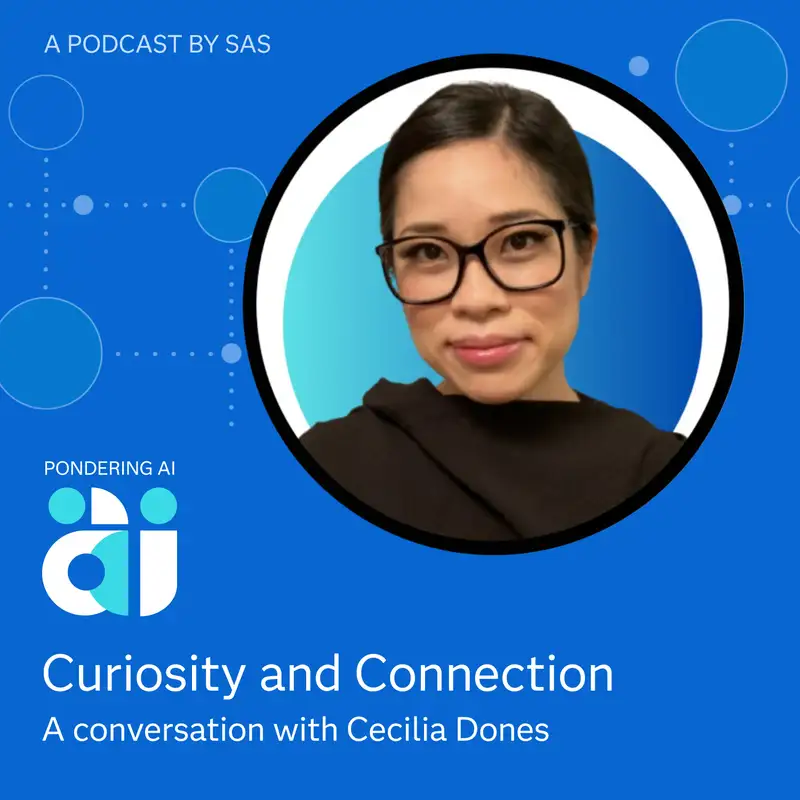
Curiosity and Connection with Cecilia Dones
KIMBERLY NEVALA: Welcome to Pondering AI, brought to you by SAS. I'm your host, Kimberly Nevala.
In this episode, we're going to be pondering both marketing and strategic decision-making with Dr. Cecilia Dones. In addition to being the founder and CDO at 3 Standard Deviations, Cecilia is a faculty lecturer at both Columbia University and NYU, where she educates a broad swath of folks on both AI, strategic communications, and strategic decision-making. Cecilia, welcome to the show.
CECILIA DONES: Thank you so much. I'm so glad to be here.
KIMBERLY NEVALA: Oh, it's our pleasure. Now, I'm interested in knowing what originally drew you to marketing? Was it the art of it, the science of it, both? And from there, what captured or turned your attention to this question of strategic communications and strategic decision-making?
CECILIA DONES: So the way I describe myself is that I have always been a researcher, I've always been an educator, so very curious about things. And I've always been very curious about telling stories about people using data. And so when I was in university the first time around, everyone wanted to go into banking. And that's where all of us that had very good quantitative skills would go. And I said, ooh, OK, no.
I was much more interested in people. And so that's when I kind of fell into marketing. And specifically it was a course in marketing research and consumer behavior when I realized, oh, OK, I can understand more about people if I study this. And so that was really the first part of my career where I was very much focused on figuring out, OK, why are people doing what they're doing? And is there a story to be told utilizing data?
And the communications part came along because I realized words matter. And I also realized that we use words as a means of sharing pieces of ourselves with each other. And that's also another form of connection. And so I got also very interested in understanding when connection happens really, really well. And that's wonderful, and we're flowing, and we have a good conversation. And when it kind of breaks down, when we start to get silent, when we start to insulate ourselves. And I think in context of today and what we're experiencing with technology mediating our lives, it is very easy to shut down. It is very easy to stop trying to connect to others.
KIMBERLY NEVALA: Yeah. And I think, as you said, it is a question that - it's probably always been salient, it's probably always been important - but is becoming increasingly so in today's AI-mediated environments. And certainly the purveyors of the platforms and some of the big AI systems as well would like it to become the sole mediator of a lot of those experiences.
But, so before we jump into that aspect of the current environment, I'm interested in as you are working with, probably still researching, how organizations are engaging and trying to utilize AI - and maybe we'll just start at the brand level - are there particular blind spots or areas where organizations just broadly have unrealistic expectations about what AI can, or should, do for them in this area?
CECILIA DONES: So I don't know all organizations, however--
KIMBERLY NEVALA: Fair.
CECILIA DONES: --if I were to think about what a lot of organizations are doing or what we can observe from the outside, I would be very curious if I was a data leader, an executive leader, sitting inside of an organization: how did my organization respond when big data became a thing? When cloud computing became a thing? How did we respond then? Did we have outside expectations as a result of it? In what areas of my business did I have outsized expectations as a result of the shiny new objects related to technology?
The reason why I say this is the funny thing about humans: we love our patterns. And so technology changes have always been part of the business cycle. And so this is not new from that perspective. And so I would be very curious to take that moment to self-reflect and think, where did we actually overstretch our expectations with those previous large changes in technology? And that would be the areas I would start to poke into.
I think many organizations are challenged at the moment because there's so much exogenous or outside change happening. Geopolitically, economically, et cetera. Even weather, et cetera, et cetera. That it can be very easy to just pay attention to outside signals and divert energy or divert attention away from the Insight signals inside of your business. And so at the end of the day, many of these organizations have been profitable, have been successful for many, many years, forgetting that core of what they do best just to chase potentially a shiny object. That's where I find many organizations struggle. And so create the space to actually reflect and think through, what did we learn from previous changes? And are we actually seeing ourselves do the exact same thing again.
KIMBERLY NEVALA: And are you then-- I know that you think very deeply and about some of these questions and areas. Where we are both perhaps creating friction where it doesn't need to be and also areas where we might be removing friction where it is, in fact, helpful. So from your perspective is our use of AI, and you can go as broadly or into specific instances as you see fit there, strengthening or weakening the brand experience or how customers are experiencing brands today? What should be we-- what should we be keeping our eye on there?
CECILIA DONES: So from a brand perspective, I'm always thinking of OK, the firm in the context of its ecosystem. So if I think of very well-established brands and let's just say Coca-Cola, Apple, brands that are globally well-known. The wonderful thing that AI does is it can keep that branding quite consistent. There's a lot of information around these very large, strong brands in the ecosystem. And so AI can help to reinforce branding, which could be a good thing if that's what they want to do.
If you are a smaller brand, newer to the market or maybe it's highly competitive that market. Or maybe you're in a sector where, frankly, it's almost like a utility and, therefore, brands are somewhat interchangeable. This is where AI can amplify a message but that message may be confusing. Why do I say that? Because there's just not a lot of information about your specific brand and your category is very noisy.
And so what we do know about AI, and specifically we're talking about generative AI, is that when the signals aren't so clear or there's a lot of noise inside of that signal, it does its very best. But that doing its very best can sometimes create errors, it can sometimes create hallucinations. So if you're a smaller competitor brand, this is where I would argue, is it worth it at this point in the game to want to scale utilizing AI? My argument: always quality over quantity. Smaller brands, I would say quality.
KIMBERLY NEVALA: Well, and this quality over content, or quality over quantity question - and I'll diverge and then come back and you'll help keep me on track here - I suppose comes down even below that to this level of content. Where just because you can doesn't mean you should. And you somewhat provocatively recently wrote a post, an article, that said AI slop is actually what the industry needs. I suspect it relates to what you just said in some way. But what did you mean by that? And why was it, what inspired that, I would say provocation, but I'm not sure it's provocative in the way that we might typically use that word.
CECILIA DONES: No. So something that I've always been fascinated about when it comes to the internet and digital - and I'm also a digital native, so I am part of the ecosystem that I also critique - is that we're very obsessed with more data about our consumer. We can be more personalized, more personalization, know our consumer even better, more and more and more data points. And so I always get very curious, OK, let's take this idea to its extreme conclusion. OK, we have an N equals 1, we are only specifically speaking to you. What does that mean in terms of the amount of variations a brand would need to support? In terms of all the different colors in the rainbow, all the different words to say good, all the different words to say here are the benefits of my product to every single variant of a consumer?
When you're literally only speaking one to one, at what point do you lose the connection of the affinity a consumer may have to brand and the recognition of that brand to others. Meaning, why do I choose to use certain brands in public? Maybe I'm trying to convey status. So when I'm ordering a drink at the bar, I don't order well liquor. I might order a branded name because I'm trying to communicate something. When the personalization gets so unique that we no longer have a joint experience, how do we socially signal? It becomes very difficult.
And so, for me, where I got very interested with the idea of: is AI slop really the bad thing? I would argue no. Why? Because it's forcing, it's that forcing function, that is forcing marketers to realize, wait, do I really want to take that personalization to the extreme conclusion? Do I really want to just have one to one advertising literally? Content, media, all of the checkpoints? Or do I want some thread, some kind of brand spine, some type of consistent narrative such that when someone uses - I'm thinking the alcohol industry at the moment - when someone calls for a specific brand and they recognize, hey, you know what I know, I like that brand too.
And it's the AI slop is giving us that opportunity to be choiceful about, do we really want to isolate our consumers to one, literally, person? Or do we want to have some kind of cultural narrative that brings community together? And I would argue for many brands, the strategy moving forward is actually nurturing the communities; not necessarily using all the data to get to one-to-one literal advertising. So AI slop is that mirror to allow us to have that moment to say, are we actually doing the right thing to our consumers as a result of all this data?
KIMBERLY NEVALA: So that's interesting. And, in some ways, what I hear you saying is that it's allowed us to take something that we were already doing, or a hypothesis that we were leaning into, and scale it to such an extent that we're really realizing, wait, maybe that wasn't quite doing what we thought it was going to do. Or even what people wanted to do.
And you brought my attention to some interesting research and reports recently about this issue of trust versus attention and the fact that they don't, in fact, move together.
And I do think there's a predilection sometimes to think, well, if I personalize it. If I'm saying Kimberly out loud in a video or writing her name in the top of an email, and trying to hyper-personalize or trying to be so precise about letting her know that I know her now. I particularly, I will just put out there as my listeners already know, I am the one who is particularly turned off by you pretending you know me. And it actually will work the opposite way. But I think I'm just perhaps cantankerous in that way.
So that then plays into this as well; which is it's not about just more and even just hyper-targeted. Because just because you get someone's attention doesn't mean you have their trust. Can you talk about that dynamic and how we're seeing that play out right now in this AI-mediated age?
CECILIA DONES: Yeah. So the good news is - and I've been watching and been participating and been a builder also within the marketing and advertising ecosystem for a good amount of time - and we are moving away from cost-related metrics in terms of measurement. Meaning, oh, I spent all the money, congrats, to something that's more of a tension. And I think that is an appropriate move for the ecosystem and appropriate move for the industry.
So it is the recognition that, OK, just putting as many things out there is not necessarily ideal. Not only from a cognitive perspective, we can't absorb all this information, but also in terms of the consumer experience. Meaning, if I'm always being assaulted with advertisements, at some point, I become numb. Or at some point I have internet blindness and I can't see the ads anymore. So focusing on attention, bravo. Yes. Thank goodness, 20 years later, we are finally really putting a lot of energy into that space. Fantastic.
However, to build that effective relationship with a consumer and a brand, it's not just being the loudest in the room. There's a repetitive experience a consumer has to have with a brand that, oh, when I've interacted with this brand, I've received some positive feedback. I've had a positive experience. When I check with others, because we are social creatures, when I talk to about others about this brand I get positive feedback. Oh, that's wonderful too. This brand is consistently working for me. Come on, I just really need my phone to work. Those kinds of experiences is what's required for trust.
So not only being able to demonstrate competency, consistency, and all of those benefits over time. And so that's where I feel that when it comes to just looking for attention sometimes - and what we've learned, at least in the social media side of things - that attention-grabbing things are not necessarily things that are the items that will help build the long-term type of trust relationship.
So the Venn diagram of things that grab attention, why do things grab attention? They grab attention because they surprise us. They may be eliciting an emotion. And because the things that surprise us or elicit emotions, over time it becomes a little bit more and more extreme. And so we see this in messaging. And, in some domains, like politics, for example, we see extreme amounts of messaging and that's what grabs the attention.
But, again, grabbing the attention, if you look at the Venn diagram of attention and trust, they don't necessarily fully overlap. Yes, you need to grab attention. I need to look at you versus another person. Or your brand versus another brand in the category. However, it's all those other experiential things that brands need to think about if they actually want to build trust.
So when it comes to specifically marketing, and when I do speak to marketing leaders, I'm always about talking to them about what is your experiential activities related to consumer activations and brand activations? And how are you taking those potentially real-life activations and augmenting it with technology? So you may have some digital capture of information but maybe you utilize technology to enhance the experience of the consumer. So I'm always trying to think about, yes, you have to grab attention, however, that's not the full requirements to build towards trust.
KIMBERLY NEVALA: And are there examples that you can share of an organization or an activation or a strategy that is really demonstrates doing this well and perhaps one that does not?
CECILIA DONES: OK, so I generally don't name and shame, but I will give you an example that I find fascinating.
KIMBERLY NEVALA: Fair.
CECILIA DONES: So another hint and trick for those listeners who are interested in this domain space and want to think about, oh, what are other ways of what could be the future: I tend to look a lot at Asia-Pac. So in South Korea, China, for example, in terms of how they've integrated technologies into their lives. How their consumers tend to either trust or distrust, how consumers utilize technology to actually navigate the consumer experience and things they want to buy. And something that I find continuously fascinating is the influencer space in those areas.
And what I mean by that is that you may have a physical retail store - so if I were a consumer and I was interested in a new fancy jacket - I can physically go to a retail store and touch the jacket, feel the jacket, try it on myself. However, inside of the physical retail store, they will also have areas where influencers with the lights, with the cameras, with all of the accouterments that is necessary, accessories that are necessary to do live streaming, will also be in the store. And so you may have real life influencers talking about the products as well and have a live streaming component.
And so there's something very interesting in that. In the sense that not only are you have a physical experience, yes, I can go into a store and try on stuff but I'm also having this digital experience as well. Meaning, I mean, I could also be part of a live stream where an influencer is talking about the brand as well that's also physically in the store. And so it is an interesting phenomenon that I'm very curious if more Western markets will adopt at some point.
But it also speaks to the acceptance of, specifically, influencers in those markets. And what's so interesting is also in those markets, you'll find digital influencers. So fully simulated influencers that are still very effective in terms of helping the consumer along in their exploratory journey or their consumer journey to purchase. And, in the West, we push back a little bit on that. Meaning if something looks completely synthetic, and it tries to be an influencer, we push back a little bit.
There has been some experimentation. And especially in the art space, there's a lot of experimentation. But full acceptance is something that I don't see yet, which I would be very curious about in the upcoming years. Will, as these technologies become more and more embedded and more and more ambient in many ways, will consumers change their mind about things and, therefore, these kinds of marketing influencer - digital, simulated individuals that are blending real life with virtual land - will become more accepted and utilized in the ecosystem?
KIMBERLY NEVALA: That is interesting because as you were sharing that example, where my mind started to go was that this was reinforcing that, as humans - and something you were talking about earlier on - is that we really do still want human connection. And we still look to other humans to both validate and help direct our attention but also to validate our choices and what we're doing. Everyone wants to be, nobody wants to necessarily be out of the in-crowd, per se.
And so as you were talking about a human influencer being in the physical space, I was thinking, does this, even though they're actively engaging in the digital space, does this speak to something about our craving for human connection? And this idea that human experience and experiences in real life - a terrible phrase that has almost no resonance anymore these days - where curating those types of experiences for the humans that you're dealing with will become more experiential, or more important, as we move forward?
Drew Burdick had said the human experience, the human touch is becoming the luxury tier of experience. So....and yet, on the other hand, if we're starting to see digital avatars. I don't know if that's just because they're just so good that people do that. Or it's just a statement of the digital, ever-expanding sort of digital aura that surrounds us all. So how do you think about that and where the human touch, if you will, comes into play for organizations now and in the future?
CECILIA DONES: Yes and. So part of my background, I spent a good amount of my career at L’Oreal, and I did spend some time working on the alcohol sides of LVMH. So I have some understanding, a fairly good understanding, of what it means to be in luxury. And one of the main lessons that, unless you've actually experienced it or you've had the opportunity to work with people who are embedded in that sector, something that the luxury marketers really, really understand well is scarcity, that premiumization.
And when I try to think about, OK, what can I learn from that sector that applies to technology and how technology is impacting our lives today. The yes and is, yes, I think the human touch will be part of that premium. Meaning: when you choose to actually talk to a person in the customer care center versus you're speaking to a bot that is trying to mimic a human to help you with whatever customer service need you have. I think that will be, for some brands, they will choose to position that as the premium experience.
The other component will be around personal information. Meaning if you are resourced well enough or you have the opportunity to be what, in premium or prestige or luxury type of environments, you will have the opportunity to be anonymous. Or some of your information doesn't need to be shared. And for the vast majority, well, the exchange, at least right now, the value exchange on the internet is you give me data as a consumer and then the platforms provide some kind of service. So the ability to be less known, or unknown, as well as the ability to actually interact with humans, I think, will be the scarcity of the future. That I think some brands will have to decide whether or not they want to play into that or do they want to position themselves more adjacent to that.
So, yeah, I was thinking that what's so interesting to me about the human touch is that something that we learned about from the pandemic, and I hope some of us have some memory of that time, it used to be the case that when you would have an interaction: OK, we have to have a meeting. For the most part, everyone would be in the offices and we'd dial phones, or we would decide to meet up in person in a cafe or do business lunch, or whatever it is. But we were all very clear around the social norms in professional life. And maybe, for some of us, also personal life. OK, we need to communicate. We need to communicate in person, synchronously, and co-located.
As a result of the pandemic, we all learned, oh, OK, this co-location thing, it's good; but it isn't such a necessary requirement for us to be able to communicate and work together effectively. And so something, as one of the many gifts of the pandemic that we haven't thought through yet - more of a macro societal level - is when we choose to have an interaction and we say, oh, let's meet up for coffee and we say, oh, no, never mind, is it OK if we do it over Zoom. What value are we communicating with that choice? Meaning, at least I'll speak for myself, both professionally and personally, when I say, let's go meet for coffee and I am offering up to be co-located with you - live, synchronous, and co-located - that is expressing a value. Versus, oh, can this be an email or can this be a Slack or can we do this over Zoom?
I also recognize that if you are physically not in the same location, all of these technologies to facilitate relationships, interactions, fantastic: wonderful. I have colleagues that don't live in the same time zone, don't live in the same market as me, it would be very difficult for us to work together without these technologies. However, for the ones that are literally just downtown from me, and we choose to do a Zoom versus meeting up for coffee, that's communicating something.
What that value is, where it sits in the hierarchy, how it helps or harms our interpersonal relationships, both professionally and personally, we haven't, as a society, figured out what those things are. And it's an open question that it's not on one, single person to solve. But I think it's as a collective, as we continue to interact with each other, being mindful of these values haven't been defined and, therefore, this ambiguity: how do we move collectively to start to define these things?
KIMBERLY NEVALA: Yeah, it's such a great question. And it's interesting. I love that framing of this as a gift of a question and a gift of a challenge from the pandemic. So I love that. And maybe that comes from your background in communication and narrative and setting frames that allow us to have discussions for things that are not always comfortable.
And this brought to mind, as you were speaking there, I've seen some commentary recently about what brands are signaling to customers when you just shoot off an email that is clearly generated by a bot. Or, when I call in, it takes me a long time to get through a bot farm to get to somebody when I need help. And I've shared this before on the show where, back in the day, when I was managing consulting teams and they'd get very upset when customers were calling and we were complaining about things. And I said, no, this is good. Because if they are telling us what hurts and what is going wrong, it means they still trust us and still have skin in the game for us to engage with them and correct it.
What I am worried about is when they are very, very quiet - or just nodding - and things are going awry, and we don't hear about it until later. So the customer who is complaining is actually the customer that is engaged. And it was a really different way of spinning that frame. So how does this then, that question, show up in how brands think about that interaction with their customers and where to deploy AI and where not?
CECILIA DONES: Yeah. So, oh, gosh, I really loved your story. And the reason why I love your story is that the opposite of brand love... And I have been asked in the past to measure brand love and, as a researcher, I say, hmm, curious construct, how are we going to do this? But the opposite of brand love is not brand hate, it's brand apathy.
So exactly to your point, when the consumer stops engaging or even worse - and this is where it's still an open question about whether or not it's truly worse - when the consumer puts up their consumer machine to interact with the business or brand machine, is that a form of apathy? It's an open question. We don't know yet. But it's apathy, that's actually what harms most brands and most relationships; again, both professionally and personally.
So this makes it very fun, fantastic in terms of, oh, this is a wonderful research question. It can also be quite fascinating and frustrating if you are on the brand side. Meaning all of the different kinds of consumer touchpoints, so whenever consumer interacts with a brand. So it could be in a physical store, that's a little bit more obvious. It could be on a website, sure, why not. It could be on an advert that the consumer received through their connected TV that is just tone deaf and interrupting their viewing experience and now has annoyed them. There are many different touchpoints, both digital and physical, between a brand and a consumer.
And the challenge now is taking all of those touchpoints, the topology of all of those touchpoints, and being very mindful of these are touchpoints that are meant to provide utility. What do I mean by utility? It reinforces brand benefits, it reinforces ease of use; those kinds of things that we do want when we want consumers to use a brand or adopt a technology. Versus these are relational, transformational, touchpoints that are meant to increase brand trust, increase brand equity, increase the willingness of the consumer to lean in and continue to want a relationship with this brand. It's always very difficult.
So, again, I mentioned I've worked in luxury for a while and I've also worked across other sectors as well; so financial, automotive, CPG, and pharma as well. And what I always find so interesting about all of the sectors is that there's always this pressure in marketing to figure out what is the ROI. And I would argue all business functions are very much worried about what is the ROI. And I always say, how do you measure the ROI of brand love? Should we quantify that? Is the relationship between a consumer and a brand a little bit more than just a number? Some of my quantitative friends would disagree with me, for sure.
But I would argue, and this is why marketing and branding is so fun and why I love the space, is, again, the choices we make about which brands we engage with, what products we choose to consume, are reflections of us trying to create an identity and communicate that out to others so that we can connect with others. And so I find it very interesting that across sectors, and also in luxury as well, the choice of trying to quantify the very activities that are all about brand building, brand equity, brand trust.Sometimes, if we over scrutinize them, I would argue we lose a little bit of the 1 plus 1 equals 3.
Then, when it comes to data, obviously oversimplifying and people can disagree with me all they want and I'm like, yes, let's disagree. But if I were to create a dimension around the philosophy around data, you have two camps.
So you have a camp of folks that very brilliant, very smart, however, they're only interested in what can be ones and zeros. If it is something I can measure, if it is something that fits in the spreadsheet, if it's something that can live in my data cloud, fantastic. That is what, that is the most important thing and, therefore, put all the energy towards that. Anything else that I cannot measure, like consciousness - that's something that we struggle to measure - irrelevant. Irrelevant.
Then you have the other extreme side of the camp, which is, oh, there's so much in the world that we totally don't understand. And there's so much that we do not capture in ones and zeros. Then how is it possible that we have this thing called consciousness? Or how is it possible that despite so many years without AI, we have these successful titans of business inside? Of organizations that have built a glorious and wonderful brands that have outlasted the test of time? Oh, wait, there's these things called tacit knowledge, knowledge that we can't really explain well, knowledge that we know has some impact because we can't translate it to a machine yet. So something that does not live in ones and zeros. Something that is institutional knowledge or tribal knowledge. You have that camp.
And then, obviously, everyone is more likely than not normally distributed somewhere across that entire spectrum. However, depending on where you start in terms of that data philosophy, I think, determines a whole lot around the perspectives you want to take when it comes to the ecosystem. I share this because I know having debates is really super fun and I know many, many a lawyer that loves to have debates. However, what's so interesting about that is often there's a lot of commonality if we understood our underlying first principle type of assumptions.
In fact, it was several weeks ago, at this point, that I was participating painting in a friendly debate regarding policy legislation. I live in New York City, so I'm based in New York, regarding the state legislator, legislation, and what they were considering in terms of AI regulation. And so it was a friendly debate to decide pro or con. And it was in front of a whole room of individuals that were highly educated about the topic and had opinions themselves.
And one of the attendees had come up to me afterwards and said, oh, this is a wonderful space. It's great that we're able to communicate and talk about these things and not hate each other over it. And I said, yes, that's true. But they started asking me all these things about the position I was asked to take. And I said you want to know the truth? Actually, myself and the other person debating, we actually agree a bit more about the topic than what was on stage. The point of what was on stage was to show the dispersion of different ideas.
And so when it comes to, again, this philosophy of whether or not do you think everything is reduced to ones and zeros or do you think there's something more than ones and zeros. I recognize it's a framework. It's great. But I also recognize that there's a lot of nuance that needs to come out and that we actually have a lot more in common when, even when, we have these kinds of debates.
KIMBERLY NEVALA: What an exciting forum. And I also love the fact that you're so honest and forthright about, hey, we're doing a debate and so we're taking very purposefully a side and the opposite ends of this sort of spectrum, so that folks get the full, not the full experience, but get the full range of perspectives and, therefore, we can make the right, not the right decisions, but we can make a decision or think about this collectively.
And I suppose that comes back a little bit to your company. It's named Three Standard Deviations, which is really all about encompassing all of the data points and perhaps thinking a little beyond just the standard and standard components in the middle. So was that a deliberate - I have to imagine that was a deliberate - choice in terms of thinking when naming the company?
CECILIA DONES: Yes, it was a very deliberate choice. So my technical background: I'm a statistician by training, so I really love something about statisticians. Many of us spend a good amount of time trying to figure out what are the factors that explain the phenomenon in the data we're seeing. Which is great, very helpful. Helps us do prediction. We do it a lot.
For me, I was always interested in trying to explain or at least trying to understand a little bit better the unknown unknowns or what would sit inside of the error term. So I was always the statistician that was like, OK, you built a model, that's great. it's explaining a lot. But what's this thing that we don't know anything about and we can't really explain very well? What is it? What is it doing? Why is it like that? So I was always interested in the kind of fringe or the edges of that.
The name of the company itself so it refers to the Gaussian curve or normal distribution or bell curve. If many of us went to school, that might have been very, very important when it came to grades for us to understand. And so it's also related to my personal philosophy, which is that we can spend an enormous amount of time and attention in our lives hanging out at the mean. The mean is great. Average conversations are great. It's how I get my coffee every day. I say hello to the person who helps me get my coffee, of course. It helps to facilitate all sorts of social interactions, which are very helpful. The pleasantries when we greet our neighbors, the pleasantries when we say hello to our colleagues, all very important things that we do to help make sure that we are all connected still.
But they're at the mean. They're very average, you say quite often. But the transformational, the experiences, the opportunities, the things that change the trajectory of your life, it never happens at the mean. That's average. It tends to always happen at the third standard deviation. So, by definition, if you understand the mathematics of the bell curve or can visualize it in your mind, it is at the tail ends. And also, by definition, it is very rare.
And so, for me, the journey of finding those three standard deviation moments, and helping others to find their own three standard deviation moments, or helping businesses to realize value that's at the third standard deviation and not at the mean, that is a wonderful purpose. And that's why I named the company that.
KIMBERLY NEVALA: That is a fabulous purpose. And I think we all need to get a lot more comfortable operating in those spaces that are outside of the average or the normal or even the expected. And perhaps this, then, provides some insight for all of us as to your interest and work and writings recently about decision-making in the current moment. Where you've said the challenge isn't about coming to an answer, or even the right answer, but about operating under uncertainty and in the face of ambiguity.
So talk to us a little bit about why this is such an important conversation right now and what you would really like organizations to be, or would recommend organizations really think about, leaning into when they think about how do we make decisions? And what are we actually expecting to happen here when we're trying to make some of these really consequential decisions?
CECILIA DONES: Yeah, so I think one of the challenges right now, and a historian can definitely correct me on this one, is that there's so much going on outside. There's so much going on exogenously that for the individual or for the team or the firm, it can feel like, OK, I have to pay attention to geopolitical challenges, I have to pay attention to the rising price of energy, I need to pay attention to this and that, da, da, da. And so that can cause some organizations to divert energy away from decision-making that's focused on making sure that the firm continues to move forward and continues to grow in the way that they choose to, that they want to.
Growth because of accident, I mean, that's serendipitous. It's wonderful. But it's hard to repeat, especially if it was by accident. And so this is where I encourage leaders to really think about, how do we want to grow? And then how much of our decision-making is focused on helping us to grow in that way. And the good news is there's a rich body of literature. And, yes, I am also a professor, and, therefore, I do provide homework at times. But there's already a rich body of literature that has already studied very, very well how businesses grow, how brands grow.
And, therefore, we don't need to reinvent the wheel. We just need to focus our energy and attention towards those types of activities. And I would also say that for leaders, you have very good teams of people that are around you. And part of the challenge, especially in this particular environment, is that, in many conversations, I'm noticing that there's extra incentive to be right and be correct and be the one that is correct and right. And I think that tends to limit ideas. And that tends to create a lot of yessing versus a lot of, is this the right thing to do for the business?
And so the idea that I would hope leaders would consider as well is how do I create the psychological safety in my leadership team such that disagreement, with evidence, we can actually have those debates. I think that's going to be very, very important now and in the upcoming future. Because the more craziness that's happening on the outside, the more exogenous pressure from multiple things happening all at once, means you're going to need people that understand each of those different factors of craziness and unstability that's happening, to be part of your team so that you can collectively make a better decision.
I am very cautious and I suggest teams also be cautious against leaning towards, oh, it must, all of this needs to, concentrate in one person. The decision-making rights should concentrate in one person. No. My argument is the more chaotic things are, the more you need multiple perspectives that will most likely disagree because they're expert in what they do individually. Or they're expert in the specific fields of understanding and they will have data and they will be quite reasoned. Those kinds of spaces and teams are more likely to do better in the long run. And so, me as a leader, how do I create that psychological safety?
KIMBERLY NEVALA: Yeah, and so it sounds then that informed disagreement should in fact be the objective. That should be the outcome you're striving for. Not the-- not uniform consensus on one right answer. Because it's likely that there is never just a one right answer and, B, never one perfect right answer either.
CECILIA DONES: Yes, exactly, exactly.
KIMBERLY NEVALA: All right, so as you can probably tell from the questions and ping ponging a little bit. Or, as I say, I'm always hopping from a lily pad to lily pad for all of the various aspects of your work. What is it that you are really most attending to or interested in looking at? What questions are you asking? Where are you going to direct research at this moment of time?
CECILIA DONES: OK, beautiful, love that question. Thank you.
So I am a big proponent in, maybe through line of this entire conversation is, I'm very interested in human agency. So how are we practicing our ability to take action and create impact in our environment? And so I'm also equally as curious when we choose not to practice human agency or when we inadvertently give away our agency.
So we were speaking earlier about friction. The nice thing about technology is it removes the friction. Oh, you don't have to do it. The machine will do it. OK, yes, true, and the machine will do it consistently. And, in some cases, they may do it better. But that also means I have to give my agency to the machine for the machine to do it. And so related to that idea is the construct of consent.
Meaning, did I actually informed choose to give away my agency to the machine or did I accept it as a default because, well, that's what we do now? And I'm very curious about the systems that have been created to obtain consent, maintain consent, and sometimes subvert consent and human agency. So those are the ideas that I'm very much interested in exploring further, especially in digital environments.
And then the extension of that is, just like the lesson we learned from Zoom: oh, no, oh, wait, what does it mean when I choose to want to have a coffee with someone in person? How do the lessons we learn in virtual environments expand into in real life environments or physical environments?
So, yes, I'm very much interested in studying agency and consent and those related ideas of trust, et cetera. And how than in virtual environments, what we've learned there and what we continue to learn, how does that lead into our fuller lives? Which is, at least for right now, I will speak for myself, I live in the real world. I don't fully live in virtual environments. Sorry, metaverse. And, therefore, what do I take from this virtual lesson that would apply to my fuller life?
KIMBERLY NEVALA: It's a great challenge for all of us to think about that moving forward. And, as folks know, we are big on and very curious about these concepts about agents - agency and consent here on the pod. So we'll be curious to learn what you have been learning as you move forward. And hopefully, at some point, we can have you back and you can tell us a little bit about that and help us think about that more broadly. So, with that said, I just want to really thank you for sharing all of the ideas and the insights with us today. And I've really enjoyed engaging with your work as I silently lurk on LinkedIn and in other places. And it's been a huge pleasure to get to talk to you in person, virtually though it may be.
CECILIA DONES: We will have to do it in real life at some point.
KIMBERLY NEVALA: Yes, let's do that. Let's do that. Well, thank you again. It's been fantastic to have you on the show.
CECILIA DONES: Brilliant. Thank you. And thank you, listeners.
KIMBERLY NEVALA: Absolutely. Now to continue learning from thinkers, doers, and advocates such as Cecilia, you can subscribe to Pondering AI. You'll find us wherever you listen to podcasts and also on YouTube.
[MUSIC PLAYING]
SPEAKER: This has been a SAS podcast.